My dad's phone rang on a Tuesday in March 2022 with a caller ID that read "IRS," and by the time anyone in the family caught on, he'd already driven to three different Walgreens and loaded almost five grand onto gift cards for a man who was never going to send any of it back. Two months later it was my turn — my card got skimmed at a gas pump and someone spent an afternoon buying patio furniture with it. That's the year I became my family's unofficial identity theft desk (nobody voted on it, I just answered the phone the most), and it's the year I actually sat down and read what these monitoring services promise against what they pay out when something goes wrong.
This page is that homework, organized by the three things you're really buying when you sign up for one of these: monitoring, insurance, and restoration. I've tried to keep the numbers here — the coverage limits, the reporting windows — as close to what the providers and reviewers actually say as I could get them, because half the marketing copy in this space treats "total protection" like it's a real thing you can buy. It isn't. No service prevents identity theft. They just catch it earlier than you would on your own.
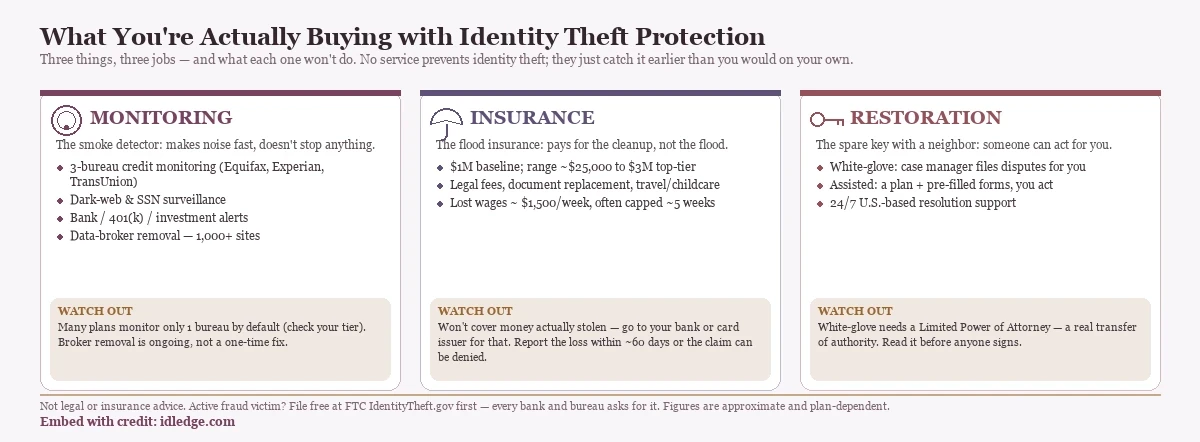
The line that saved me a pointless insurance claim: identity-theft coverage pays for the cleanup — legal fees, lost wages, replacing documents — but not the money actually taken from your account. When my card got skimmed, the bank reversed the charges in about a week, because that's a fraud dispute, not an identity-theft claim. Knowing which one you're dealing with, before you file anything, is half the battle.
Monitoring Features and Scope
Monitoring is the smoke-detector part of this — it doesn't stop anything, it just makes noise fast enough that you can. Every service in this space runs some version of the same automated scans across your credit files, the open web, and (allegedly) the dark web, watching for your information showing up somewhere it shouldn't. Where they actually differ is how wide that net is and how fast it pings you.
- Three-Bureau Credit Monitoring
- This is the baseline most plans lead with — continuous tracking of your credit files at Equifax, Experian, and TransUnion, with alerts when something new shows up, like a new account application under your name (Security.org). The catch I didn't clock until I was already paying for it: a lot of "identity theft protection" plans only monitor one bureau by default and charge more for all three — so check which tier you're actually on before you assume you're covered everywhere.
- Dark Web Surveillance
- These scans crawl forums, marketplaces, and breach dumps for your Social Security number, birthdate, bank account numbers, credit card numbers, and property records showing up somewhere they shouldn't (Security.org). When I ran my dad's information through one of these after the scam, it turned up an old, closed bank account number from a bank that folded a decade ago — useless to a fraudster, mildly terrifying to see anyway.
- Social Security Number (SSN) Monitoring
- Detection of your SSN showing up attached to a name or address that isn't yours — in public records, on a credit application, wherever. This is the one that would have actually caught my dad's situation faster, except gift-card scams don't touch your SSN at all, which is exactly why he didn't see it coming.
- Financial Account Monitoring
- Tracking of bank accounts, 401(k) balances, and investment portfolios for large withdrawals or account transfers — most plans bundle this into the same feed that flags new account applications and card activity (Security.org). This is the feature that would have caught my own card getting used at that gas pump faster than the "call us if you notice something" default most banks run on.
- Data Broker Removal
- Automated requests to people-search sites and data brokers to take your information down — and it's ongoing work, not a one-time fix, because the sites re-list you. Some add-on tools cover more than 1,000 individual broker and people-search sites (Security.org). I ran my mom's name through one of these last year and watched five sites pull her listing down over about three weeks, then two of them put her right back up a month later. Nobody warns you it's a subscription to a fight, not a one-time fix.
Quick aside on what I've actually paid for, since I said I'd be honest about the misses too: we ran McAfee+ for my parents for about four months because it was the cheapest bundle and came pre-loaded on my dad's new laptop. I cancelled it that summer — the dark web alerts were generic ("your email was in a breach," zero context on which one), and there was no restoration authority option at all, which matters a lot more once you've actually needed someone to act on a family member's behalf. We moved my parents to LifeLock instead and kept Norton 360 with LifeLock on my own accounts, mostly for the antivirus bundling.
Insurance Coverage and Limits
Think of this the way you'd think about flood insurance — it doesn't stop the water, it just means you're not the one paying to replace the drywall. $1 million in coverage is the baseline the industry has settled on for identity theft insurance across "all plans," premium included (CNET), and coverage across the industry generally spans $25,000 on the cheap end up to $3 million on the priciest plans — LifeLock's top tier splits its $3 million into $1 million each for stolen funds, legal fees, and personal expenses (Security.org). The categories these policies actually pay out under are fairly consistent across providers: legal fees, lost wages, document replacement, travel costs, and childcare tied to court dates (Experian) — lost-wage coverage specifically is often capped at something like $1,500 a week for a handful of weeks, not an open-ended payout.
Here's the part that isn't obvious from the marketing page, though: most of these policies won't touch money that was actually stolen out of your account — you go to your bank or card issuer for that, and the insurance covers the mess around it instead (CNET). That's basically what happened with my own card — the bank reversed the furniture charges in about a week, no insurance claim needed, because that's a fraud dispute, not an identity theft recovery.
| Coverage Category | Description of Reimbursable Expenses | Standard Limits (Approx.) |
|---|---|---|
| Legal Fees | Costs for attorneys to defend against suits or remove fraudulent criminal records tied to your identity. | Up to Policy Limit |
| Lost Wages | Compensation for time taken off work to meet with professionals, banks, or law enforcement. | Plan-dependent — e.g. up to $1,500 per week, capped at five weeks, on some policies |
| Stolen Funds | Reimbursement for money taken directly from bank or investment accounts (many policies expect you to pursue your bank first). | Varies by Plan |
| Document Replacement | Fees for replacing driver's licenses, passports, or birth certificates. | Actual Cost |
| Travel & Childcare | Costs tied to attending court hearings or meetings with recovery specialists. | Varies by Plan |
Restoration and Recovery Services
Restoration is the spare-key-with-a-neighbor model — someone else has the authority to act on your behalf when you're too underwater to make every phone call yourself. That sounds nice right up until you realize "authority to act on your behalf" is a legal document, not a customer-service nicety.
- White-Glove Restoration: A dedicated case manager handles most of the recovery — contacting bureaus, filing disputes — usually after you sign a Limited Power of Attorney (LPOA). One review flagged a competing service specifically for not offering an LPOA-based recovery option, which tells you it's treated as a real feature, not paperwork theater (Security.org). Family plans are increasingly assigning a restoration specialist to each covered member rather than one case manager for the whole household (Money.com). I read the LPOA language twice before I let anyone sign one for my dad — it's a real transfer of authority, not a formality, and that's worth five extra minutes.
- Assisted Restoration: Specialists hand you a step-by-step recovery plan and pre-filled forms but don't act on your behalf. This is what I did myself for the gas-pump card — no service involved, just a call to the bank and a police report for the file. Took about a day. Not every case needs the white-glove version.
- 24/7 Resolution Support: Round-the-clock access to U.S.-based recovery support to get the process started whenever you notice something's wrong (Money.com) — which, if you've ever discovered fraud at 11pm, is exactly when you want it and not at 9am the next business day.
Summary Comparison of Service Tiers
The following table compares standard features across basic and premium service tiers in the 2026 market.
| Feature | Basic / Entry-Level | Premium / Top-Tier |
|---|---|---|
| Credit Monitoring | 1-Bureau (usually Experian or Equifax) | 3-Bureau (Equifax, Experian, TransUnion) |
| Insurance Limit | $25,000 – $1,000,000 | Up to $3,000,000 on top-tier plans |
| Restoration Model | Assisted / Self-Service | White-Glove / Dedicated Case Manager |
| Dark Web Alerts | Basic (Email/Password/SSN) | Comprehensive (bank accounts, credit cards, property records) |
| Financial Alerts | None or Limited | Bank, 401(k), and Investment Monitoring |
| Digital Security Tools | None | VPN, Antivirus, Password Manager |
Last verified: 2026-07-16
Sources
- Security.org: Best Identity Theft Protection Services of 2026
- Security.org: Best Identity Theft Protection with Dark Web Monitoring in 2026
- Security.org: 2026 Guide to Identity Theft Insurance
- CNET: Best Identity Theft Protection Services We've Tested in 2026
- Money.com: Best Identity Theft Protection Services of 2026
- Experian: What Is Identity Theft Insurance?